
Speed Baccarat Rules And Gameplay For Casinos
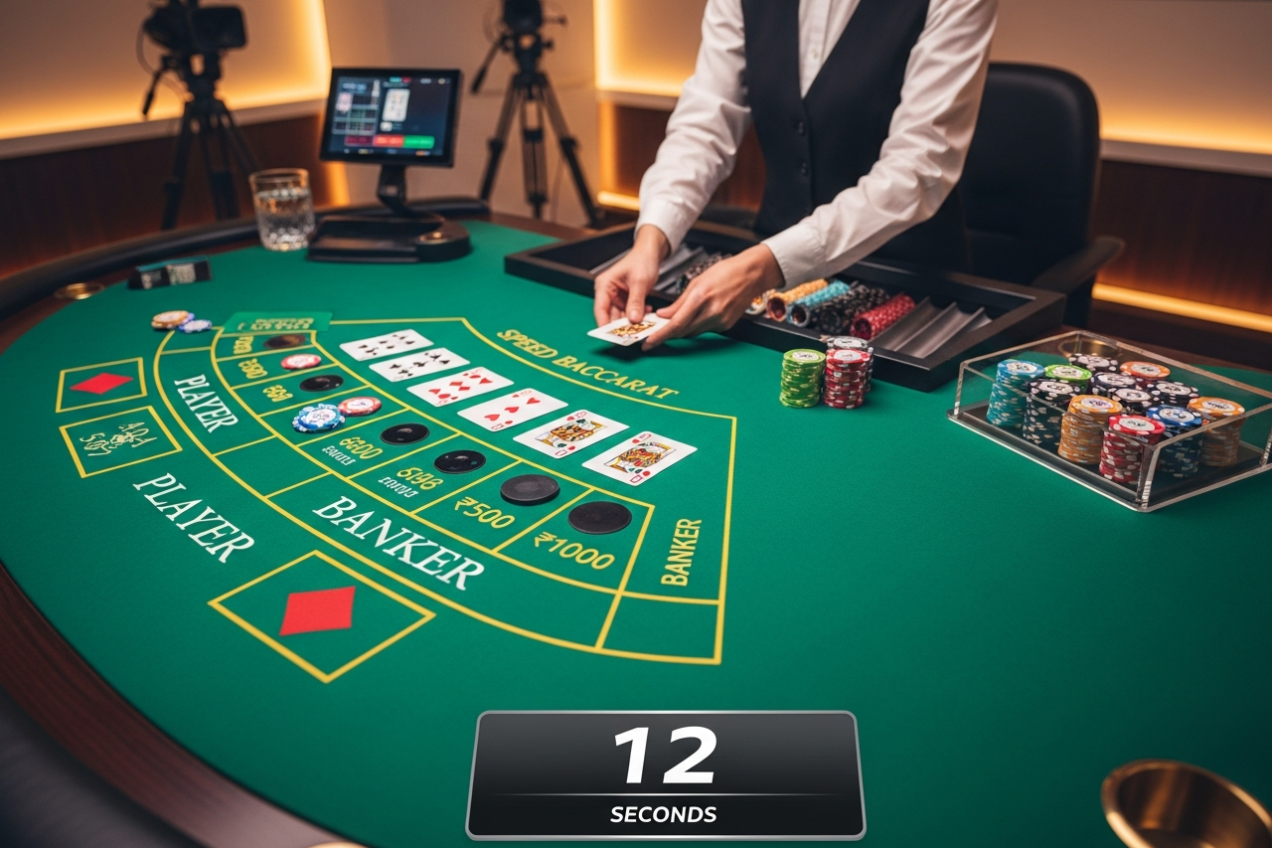
Speed Baccarat has quickly become one of the most popular live dealer games among Indian casino players, both at land-based venues and online platforms. This accelerated version of traditional baccarat compresses each round to approximately 27 seconds—compared to around 48 seconds in standard live baccarat—making it ideal for players who prefer rapid decision-making and consistent action. The game’s simplicity, combined with its relatively low house edge and the ability to stake in Indian rupees (INR), has made it a natural fit for the Indian gaming market. This comprehensive guide covers everything you need to know about Speed Baccarat rules, gameplay flow, betting strategies, and practical considerations for Indian players looking to enjoy this fast-paced variant responsibly.
What Is Speed Baccarat And Why It Appeals To Indian Casino Players
Speed Baccarat is standard baccarat compressed into a quicker format, where the dealer manages the pace with minimal animation and rapid card reveals. The core game mechanics—hand values, drawing rules, and payout structures—remain identical to classic baccarat; the primary difference is operational tempo. Most live dealer providers, including Evolution and Amusnet, stream Speed Baccarat using an eight-deck shoe, a professional live dealer, and multiple camera angles, all optimized for decision windows that fit within the 27-second round cycle.
Indian players gravitate toward Speed Baccarat for several practical reasons. First, the quick round time suits mobile and online play, where session flexibility is valuable. Second, the betting structure is refreshingly simple—three main bets (Player, Banker, Tie) with optional side bets—requiring minimal learning curve compared to games like poker or Teen Patti variants. Third, INR stake availability on most India-facing casinos removes currency conversion friction. Finally, Speed Baccarat’s low house edge on the Banker bet (typically around 1.06% after commission) appeals to mathematically-minded players seeking better long-term value than many slot games.
How Speed Baccarat Differs From Classic Baccarat
The core rules and hand values of Speed Baccarat are identical to classic baccarat. Cards are dealt face-up from an eight-deck shoe; card values remain unchanged (2–9 count by face value, 10/J/Q/K count as zero, Ace counts as one); and the objective is the same—get a hand total closest to 9. The difference lies entirely in pacing and presentation. Classic live baccarat typically features animated introductions, chatty dealers, and slower dealing sequences that stretch rounds to 45–50 seconds. Speed Baccarat strips these elements away: the dealer deals cards quickly, minimal verbal flourish occurs, and the interface auto-evaluates hand totals and announces results instantly.
A Speed Baccarat table setup mirrors standard live baccarat in layout—Player area on one side, Banker on the other, Tie in the middle—but the live studio is configured for efficiency. Camera angles focus on the dealing zone and chip racks. The shoe is positioned for fast extraction. Betting interfaces display chip values, recent results, and countdown timers in clear, accessible formats for online players.
Speed Baccarat’s Place In Indian Casino And Online Gaming
Speed Baccarat is now standard at most major Indian land-based casinos, particularly in Goa and other gaming zones, where multiple tables operate to handle demand. Online, it is available through nearly all major India-facing live dealer platforms, delivered via Evolution’s Speed Baccarat studio, Amusnet’s variants, or other licensed providers. These casinos market Speed Baccarat prominently because it attracts high session volume and offers strong operator margins.
Culturally, Indian players have long favored fast-paced card games—Teen Patti, Andar Bahar, and Rummy all rely on rapid rounds and instant outcomes. Speed Baccarat aligns with this preference while offering the mathematical transparency and regulated fairness of a licensed casino product. The combination of simplicity, speed, and lower house edge (on the Banker bet) than many alternative games makes it a natural bridge from traditional Indian card games to international live casino offerings.
Table Setup, Card Values And Hand Scoring In Speed Baccarat
| Element | Description | Relevant For Indian Players |
|---|---|---|
| Betting Layout | Three main betting areas: Player, Banker, Tie; side bet zones (if available) positioned at table edges | Clearly marked with chip denominations in INR for online; chip racks visible at land-based tables |
| Eight-Deck Shoe | Standard baccarat uses a shoe containing eight decks (416 cards) shuffled together | Ensures statistical consistency; familiar format across all licensed venues |
| Card Values (2–9) | Face value; a 7 and a 5 total 12, recorded as 2 (rightmost digit) | Used identically in classic baccarat; no variant differences in Speed Baccarat |
| Card Values (10, J, Q, K) | Count as zero | Critical for hand calculation; affects whether a third card is drawn |
| Ace Value | Counts as 1 | Lowest individual card value; rarely impacts final totals due to hand-total rules |
| Live Dealer Position | Dealer sits center-back, facing the camera; controls the shoe and chip distribution | Visible on stream; typically professional and courteous; multilingual at major operators |
| Streaming Setup | Multiple HD cameras; one on the shoe/dealing area, one wide-angle on the table, often one overhead | Ensures fair dealing and transparency; allows online players to verify card handling |
Card Values And Hand Total Examples
To score a baccarat hand, add all card values and record only the rightmost digit of the sum. This rightmost-digit rule is essential because the goal is to reach 9.
Example 1: Player receives 7♠ and 8♦. Sum = 7 + 8 = 15. Hand total = 5 (rightmost digit).
Example 2: Banker receives 10♣ and 9♥. Sum = 0 + 9 = 9. Hand total = 9 (a natural). The round ends immediately.
Example 3: Player receives A♠ and K♦. Sum = 1 + 0 = 1. Hand total = 1.
The hand closest to 9 wins. If both hands are equal, a Tie occurs. If either hand makes 8 or 9 on the first two cards, it is called a “natural,” and the round resolves without a third card being drawn.
Core Speed Baccarat Rules: Player, Banker And Tie Outcomes
| Bet Type | What You Are Predicting | Standard Payout | Notes For Speed Baccarat |
|---|---|---|---|
| Player | The Player hand will be closer to 9 than the Banker hand | 1:1 (even money) | No commission; straightforward return on win. Popular entry-level bet. |
| Banker | The Banker hand will be closer to 9 than the Player hand | 1:1 (before 5% commission) | Most statistically favorable main bet; commission reduces net payout to ≈0.95:1 but still lowest house edge (≈1.06%). |
| Tie | Both Player and Banker hands will have equal total | Typically 8:1 or 9:1 depending on venue | Highest house edge (≈14.4% at 8:1); statistically unfavorable; occurs in roughly 9.5% of rounds. Avoided by disciplined players. |
Natural Wins And Round End Conditions
A natural is a two-card hand totaling 8 or 9. If either the Player or Banker (or both) makes a natural on the initial two-card deal, the round ends immediately without a third card being drawn. The hand with the higher natural wins; if both have the same natural (both 8 or both 9), the result is a Tie.
Speed Baccarat’s face-up dealing and immediate auto-evaluation mean naturals are detected within seconds. Once the dealer reveals both cards, the system automatically scores the hands and announces the outcome. This near-instant resolution is one reason Speed Baccarat feels so snappy compared to traditional live games.
Banker Commission And House Edge Considerations
The Banker bet wins slightly more often than the Player bet due to the Banker drawing after the Player in the third-card sequence (this gives Banker an information advantage). To offset this mathematical edge, casinos charge a commission—typically 5%—on Banker wins. If you bet ₹1,000 on the Banker and win, you receive ₹1,000 (stake) plus ₹950 profit (1,000 × 1 − 5% commission), for a total of ₹1,950. This commission structure results in a Banker house edge of approximately 1.06%, compared to roughly 1.24% for Player and 14.4% for Tie.
For Indian players managing a fixed bankroll in INR, the Banker bet remains the mathematically sound long-term choice among the three main wagers. Over 100 rounds of ₹500 bets on the Banker, you expect to lose approximately ₹530 on average, whereas 100 rounds on the Player would cost ₹620, and 100 rounds on Tie would cost ₹7,200. Tie bets should be avoided unless you are comfortable with high volatility and the probability of frequent losses.
Speed Baccarat Round Flow: From Betting To Result In 27 Seconds
- Betting Window Opens – The online interface or live dealer announces the betting window (typically 10–12 seconds). Players select chip denominations and place stakes on Player, Banker, Tie, or side bets. Pre-deciding your bet size and type before the window opens helps you stay decisive.
- Betting Window Closes – Once time expires, no further bets are accepted. The dealer acknowledges the round is locked and prepares to deal.
- Dealer Distributes Cards – The dealer pulls two cards from the shoe for the Player position and two for the Banker position. All four cards are revealed face-up immediately; this is the “speed” element—no suspense, no slow burn.
- System Evaluates Naturals – The interface instantly calculates hand totals. If either hand is 8 or 9 (a natural), the round ends, and results are announced.
- Third Card Logic Applied – If no natural, the system automatically applies the fixed third-card rules. The Player hand draws or stands according to rule; if the Player draws, the Banker then draws or stands according to its rule.
- Final Totals Compared – Once all drawing is complete (typically within 20–25 seconds of card reveal), the system compares final hand totals.
- Result Announced And Payouts Issued – The dealer or system announces the winner (Player, Banker, or Tie), displays the result on screen, and automatically credits or debits balances. The entire cycle completes in approximately 27 seconds; a new betting window opens for the next round.
Decision Timers And Pace Management For Indian Players
The short betting window requires preparation. Before each round, decide in advance whether you will bet Banker, Player, or skip; decide your stake size in INR; and be ready to click within seconds. Online interfaces typically show a countdown timer (10 seconds remaining, 5 seconds, etc.), so you can react quickly without panic.
Do not fall into the trap of believing the countdown timer influences probabilities—it does not. The deck composition and shuffle are fixed; the timer simply enforces fairness by preventing late bets that would gain unfair information from early cards. Pre-decide your strategy and stick to it. If you find yourself rushing or making impulsive bets as the timer ticks down, take a break. Fast pace should never override discipline.
Third Card Drawing Rules In Speed Baccarat
| Situation | Player Action | Banker Action | Rule Source |
|---|---|---|---|
| Player hand 0–5 | Hits (draws a third card) | Depends on Banker total and whether Player drew | Standard baccarat rule; automatic |
| Player hand 6–7 | Stands (no third card) | Depends on Banker total | Standard baccarat rule; automatic |
| Player hand 8–9 (Natural) | Round ends; no draw | Round ends; no draw | Immediate win/loss/tie; no further action |
| Banker hand 0–2 | N/A | Hits regardless of Player’s action | Standard baccarat rule; automatic |
| Banker hand 3 | N/A | Hits unless Player’s third card was an 8 | Standard baccarat rule; automatic |
| Banker hand 4 | N/A | Hits if Player drew and third card was 2–7 | Standard baccarat rule; automatic |
| Banker hand 5 | N/A | Hits if Player drew and third card was 4–7 | Standard baccarat rule; automatic |
| Banker hand 6 | N/A | Hits if Player drew and third card was 6–7 | Standard baccarat rule; automatic |
| Banker hand 7 | N/A | Stands (no draw) | Standard baccarat rule; automatic |
| Banker hand 8–9 (Natural) | N/A | Round ends; no draw | Immediate win/loss/tie; no further action |
Plain-Language Guide To Third Card Logic
Here is the logic in simple terms:
Player’s decision is simple: If the Player’s two-card hand totals 0–5, the Player automatically draws a third card. If the Player’s two-card hand is 6–7, the Player stands (no third card). If the first two cards are 8 or 9, the round ends—the Player does not draw.
Banker’s decision depends on what the Player did: Once we know whether the Player drew and what the Player’s third card was (if drawn), the Banker follows a fixed rule. Broadly: if the Banker hand is 0–2, it always hits. If the Banker hand is 3–6, it hits only under specific conditions based on the Player’s third card. If the Banker hand is 7, it always stands. If the Banker hand is 8–9, the round ends.
The key insight: these are not player choices. The drawing rules are automated and apply uniformly to all hands. You cannot influence them through betting strategy or “feel.” They exist to ensure mathematical fairness and consistency across all baccarat tables globally.
Impact Of Drawing Rules On Strategy And House Edge
The third-card rules are what create the slight statistical advantage for the Banker bet. Because the Banker always acts after the Player (and thus has partial information about what the Player drew), the Banker’s outcome is slightly favored over the Player’s. This is why casinos apply the 5% commission to Banker wins—to balance the mathematical edge.
Understanding this means recognizing that strategy does not involve trying to guess or “control” the third card draws. Your only strategic choice is which bet to place (Banker, Player, or avoid Tie) and how to manage your bankroll relative to the house edge. No system, superstition, or betting pattern can overcome the fixed rules and commissions. Focus your effort on disciplined stake sizing and session management, not on predicting draws.
Side Bets And Popular Speed Baccarat Variants For Indian Casinos
| Side Bet / Variant | Trigger Condition | Typical Payout | Notes / Suitability For Indian Players |
|---|---|---|---|
| Pair (Player Pair or Banker Pair) | The first two cards dealt to Player or Banker are a matching rank (e.g., two 7s) | 11:1 | Occurs in roughly 16% of hands; moderate house edge (≈10%); optional add-on. |
| Perfect Pair | First two cards are matching rank AND suit (e.g., 7♠ and 7♠) | 25:1 | Rarer; higher payout, higher house edge; niche bet for entertainment. |
| Dragon 7 | Banker wins with a three-card total of 7 | 40:1 | Rare outcome (≈1.5%); very high house edge (≈11%); exotic variant. |
| Dragon Bonus / Tie+ | Player or Banker hand wins by a margin of 4+ total points | 30:1 to 160:1 depending on margin | Adds volatility; higher house edge (≈2.5–10% range); appeals to players seeking bigger swings. |
| Super 6 (or Super Six) | Banker wins with a three-card total of 6 | Varies (often 12:1) | Different payout rules apply; replaces standard Banker bet at some tables; consult local rules. |
| Tie+ Variations | Tie occurs, or Tie + specific card condition | 8:1 to 25:1 depending on variant | Attempts to make Tie more attractive; still typically 8%+ house edge; avoidable. |
Risk Profile Of Side Bets Versus Main Bets
Side bets like Dragon 7, Pair, and Dragon Bonus offer large payouts that can excite players. However, they occur infrequently and carry house edges 3–10 times higher than the Banker main bet. Over 100 rounds, a ₹100 Dragon 7 side bet costs you approximately ₹11 on average (11% house edge), whereas the same ₹100 on the Banker main bet costs approximately ₹1.06. The entertainment value of a occasional big win must be weighed against consistent long-term loss.
For Indian players with limited bankrolls, the best approach is to focus bets on the Banker main bet and treat side bets as occasional micro-stakes entertainment only. If you enjoy side bets, allocate a small percentage (5–10%) of your session budget to them, never the majority. This way, a lucky hit feels rewarding without derailing your overall bankroll discipline.
Payouts, Odds And House Edge In Speed Baccarat
- Player Bet: Pays 1:1 (even money). No commission. House edge approximately 1.24%. Easier to understand for new players but slightly less favorable than Banker long-term.
- Banker Bet: Pays 1:1 before 5% commission, net ≈0.95:1. House edge approximately 1.06%. Best main-bet option for low-edge play; requires accounting for commission in stake sizing.
- Tie Bet: Pays 8:1 or 9:1 depending on venue (some casinos offer 9:1 to be competitive). House edge approximately 14.4% (at 8:1) or 4.85% (at 9:1). Statistically unfavorable; mathematically weak long-term choice.
- Speed vs. Standard Baccarat Payout Tables: Speed Baccarat’s faster pacing does not change the underlying probabilities or house edge, provided the payout tables are identical to standard baccarat. An eight-deck shoe behaves the same whether cards are dealt in 27 seconds or 50 seconds. Some variants (e.g., Super 6) may alter payouts; always verify the specific table rules before playing.
Comparing Banker, Player And Tie Bets For Long-Term Play
Imagine an Indian player with a ₹10,000 session budget. If that player bets Banker at ₹500 per round for 20 rounds, the statistical expectation is a loss of approximately ₹106 (1.06% house edge × ₹10,000 wagered). If the same player bets Player, the expected loss rises to ₹124. If the player splits bets between Banker and Tie, the Tie component will hemorrhage money. Over long sessions, disciplined Banker bettors will preserve capital better than opportunistic Tie chasers.
The margin is small—less than 0.2% between Banker and Player—but over hundreds of rounds, it compounds. For Indian players in particular, where INR bankrolls may be modest, every fraction of house edge matters. Choose Banker, accept the commission, and move on.
Where Speed Baccarat Fits Among Other Casino Games In India
Speed Baccarat is simpler than poker or blackjack variants, which require decision-making at multiple points. It is more skill-transparent than slots, which are purely random. It offers better statistical odds than Tie-heavy betting or side bets. Compared to Teen Patti or Andar Bahar, it is more regulated and consistent, backed by licensed casinos and RTP-audited live dealers. For Indian players seeking fast, fair, low-edge card action, Speed Baccarat sits in a sweet spot: easy to learn, mathematically favorable (on Banker bets), and globally standardized.
Practical Speed Baccarat Strategy And Bankroll Tips For Indian Players
- Stick to the Banker Bet: Make Banker your default wager. It has the lowest house edge (≈1.06%) among the three main options. Even though you lose 5% on wins, the Banker’s statistical advantage over the Player more than compensates. Over 100 rounds of ₹500, Banker bets will preserve more capital than Player or Tie alternatives.
- Avoid or Minimize Tie Bets: A 14.4% house edge (on 8:1 tables) means every ₹1,000 wagered on Tie costs you ₹144 on average. Skip Tie entirely or place tiny micro-stakes (₹10–50) if you crave the occasional big payout; never center a session around Tie.
- Use Fixed Stake Sizing: Decide on a unit size in INR before play (e.g., ₹200 per round) and stick to it. Do not chase losses by doubling up, and do not increase stakes after wins. Fixed sizing ensures your session bankroll lasts and keeps the math predictable.
- Budget a Session Loss Limit: Set a maximum loss before play (e.g., ₹2,000 on a ₹10,000 bankroll), and quit if you hit it. Similarly, set a win target (e.g., ₹1,500 profit) and step away once reached. Speed Baccarat’s 27-second rounds mean you can burn through a budget quickly without boundaries.
- Avoid Betting Systems: Martingale (doubling after losses), Fibonacci, and other sequences do not change house edge. At 27-second round frequency, a Martingale-style string of losses escalates stakes dangerously fast. Stick to flat betting instead.
- Accept Variance: Even with optimal bet selection (Banker), short-term losing streaks are normal. Losing five rounds in a row (probability ≈4%) should not trigger panic or system chasing. Trust the math and maintain discipline.
- Track and Review: Log your bets and results, especially when playing online. Over 200–300 rounds, patterns emerge that confirm the house edge and help you spot impulsive decision-making to avoid next session.
Managing Fast-Paced Sessions Responsibly
Speed Baccarat’s accelerated pace is thrilling but risky for bankroll management. Set firm time and session-loss limits. For example, commit to 40 rounds maximum (roughly 18 minutes of play) or a loss cap of ₹3,000, whichever comes first. Use casino-provided limit-setting tools: most India-facing platforms offer deposit limits, loss limits, and self-exclusion features. Use them.
Take breaks every 20 rounds; step away from the screen for 5 minutes to reset. This interrupts momentum-based decision-making and prevents fatigue-driven mistakes. If you feel frustrated or chasing losses, stop immediately. No session is worth financial or emotional stress. Remember: the game will still be available tomorrow, and the odds will not improve from playing more today.
Playing Speed Baccarat At Indian Land-Based And Online Casinos
| Environment | Typical Features | Advantages For Indian Players | Points To Watch |
|---|---|---|---|
| Land-Based (Goa Casinos) | Physical tables, live dealers, chip racks, in-person betting. Eight-deck shoes. Ambient noise and social atmosphere. | Direct, tactile experience; no internet dependence; immediate cash-out; familiar casino environment. | Higher travel cost; fixed table hours; crowded peak times; less flexible stakes. |
| Online Live Dealer (Evolution/Amusnet) | HD stream from professional studios. Multiple table angles. Auto-calculated payouts. INR chip denominations. Chat with dealer. | Play from home; 24/7 availability; flexible INR stakes; mobile-friendly; instant deposits/withdrawals; no travel. | Requires stable internet; potential lag/freezing; screen fatigue; less social; temptation to play more due to convenience. |
| Mobile App (iOS/Android) | Optimized UI; touch betting; landscape viewing; responsive design. | Extreme convenience; play anywhere (home, cafe, commute). Seamless INR transactions. Notifications and push alerts. | Smaller screen (harder to read fine print); battery drain; distracting interruptions; easier to over-play due to constant availability. |
| VIP/High-Roller Tables | Exclusive tables with higher minimum stakes (₹5,000+), personal dealers, private studio zones. | Premium experience; faster service; higher payout potential; exclusive perks (bonuses, concierge). | Requires larger bankroll; higher swings; pressure to justify higher stakes; often stricter bet restrictions. |
Live Dealer Speed Baccarat Studios
Evolution Gaming operates the most prominent Speed Baccarat studios globally. Their Indian-facing studios stream from licensed European facilities (Malta, Cyprus, UK) with HD multi-camera setups. Tables run continuously, with shoe changes every 4–6 hours. Amusnet also provides Speed Baccarat with slightly different branding and studio configurations. Both providers support INR deposits, local payment methods, and localized interfaces in English and regional Indian languages where available.
India-facing casinos typically offer 8–12 concurrent Speed Baccarat tables during peak hours (evening and night), allowing players to choose based on table crowding, dealer preference, or specific variants (standard, Dragon bonus, Super 6, etc.). Streaming quality is usually excellent (1080p+), with dealer professionalism high and outcome integrity assured by licensed jurisdictional bodies.
Technical And UX Considerations For Indian Online Players
Fast betting windows demand reliable internet. A dropout mid-round can cost money, so use a stable Wi-Fi connection or full 4G/5G mobile signal. Verify your connection speed before playing (minimum 2 Mbps upload recommended).
On the betting screen, always confirm chip denominations in INR before clicking bet buttons. A common error is clicking a ₹5,000 chip instead of ₹500 due to screen size or inattention. Take one extra second to verify. Online platforms should also clearly show minimum and maximum bets in INR; if unclear, contact support before wagering.
Most India-facing casinos require KYC (Know Your Customer) verification—identity and address proof—before deposit and withdrawal. This is a regulatory requirement, not a scam indicator; treat it as standard for licensed platforms. Secure your account with strong passwords and two-factor authentication. Never share account credentials or OTPs with anyone.
Etiquette, Myths And Mistakes To Avoid In Speed Baccarat
- Myth: “I can predict the next card based on patterns.” False. Each card draw is independent; past results do not influence future ones. The deck is shuffled regularly, and results are determined by random dealing, not patterns or “hot/cold” trends.
- Myth: “Betting systems guarantee wins.” False. Martingale, Fibonacci, and other sequences do not change house edge. At 27-second round frequency, losing streaks escalate stakes catastrophically. A ₹100 base bet can become ₹6,400+ after six losses.
- Myth: “The dealer is biased or the game is rigged.” False (at licensed casinos). Speed Baccarat tables are audited, RNG-certified (for online variants), and supervised by regulators. Losing does not mean cheating; variance is normal.
- Mistake: Playing on unfamiliar tables without reading rules. Some variants (Super 6, Dragon Bonus, custom Pair bets) alter payouts. Always review the specific table rules before betting INR.
- Mistake: Ignoring the 5% Banker commission. New players sometimes think Banker 1:1 means ₹500 bet = ₹1,000 return. It is actually ₹950 return (after 5% commission). Account for this in stake sizing and win targets.
- Mistake: Chasing losses with larger bets. After losing ₹1,000, the temptation to bet ₹2,000 to “get even” is powerful, especially under fast-paced stress. Resist. Stick to your planned unit size.
- Mistake: Playing while emotional, tired, or intoxicated. Impaired judgment leads to poor bet selection, stake inflation, and bankroll loss. Play only when alert and emotionally stable.
How Fast Pace Amplifies Player Behaviour
Speed Baccarat’s compressed rounds magnify both discipline and recklessness. A disciplined player making flat ₹500 Banker bets can complete a planned 40-round session in 18 minutes with minimal stress. An impulsive player, however, might find the rapid pace intoxicating; the quick wins and losses blur together, encouraging bigger bets and chasing. The fast feedback loop—decision → result → next decision in 27 seconds—can feel like “momentum,” triggering overconfidence or desperation.
Protect yourself by enforcing breaks. After 20 rounds, step away for five minutes. Walk around, hydrate, assess how you feel. If the pace feels stressful or exciting in a concerning way, stop for the day. Speed Baccarat should be enjoyable, not anxiety-inducing or habit-forming.
Choosing The Right Speed Baccarat Table As An Indian Player
When approaching a Speed Baccarat offering—whether online or land-based—evaluate three factors: stake limits, commission structure, and variant type.
Stake Limits in INR matter deeply. If your monthly gambling budget is ₹10,000, a table with a ₹5,000 minimum bet is unsuitable; you can play only two rounds before depleting your session. Conversely, a ₹100 minimum allows flexible play. Most India-facing casinos offer tables spanning ₹50–500 minimums and ₹10,000–₹100,000 maximums, accommodating casual and serious players alike. Start at a table where the minimum feels small relative to your session budget—no more than 5–10% per round.
Commission structures vary slightly between casinos. Standard is 5% on Banker wins, but some VIP tables or promotional periods may offer 4% or even 3%. These small differences compound over hundreds of rounds. Choose 5% or lower if comparing tables.
Variant type reflects rule flavor. Standard tables are straightforward—Banker, Player, Tie. Tables with Dragon Bonus, Super 6, or Pair bets add complexity and higher house edges. If you are a beginner, standard tables are ideal. Once comfortable, explore variants if you like extra betting options, but understand their house edges first.
Table Limits, Currency And Localisation Factors
INR chip denominations and table-limit display in Indian rupees remove friction for Indian players. You do not need to convert between currencies or estimate USD/EUR equivalents. Casinos marketing Speed Baccarat to Indian players typically offer ₹25, ₹50, ₹100, ₹500, ₹1,000, and ₹5,000 chips, making stake sizing intuitive.
Localized interfaces—menu text in Hindi, Tamil, Telugu, or Kannada; 24/7 local payment methods (UPI, bank transfer); and dealer announcements in English with clear accents—enhance usability. Some casinos even feature Indian-themed tables or promotional tables with regional flair. These touches are not essential to gameplay but improve comfort and engagement.
When evaluating a new casino offering Speed Baccarat, test a low-limit table first. Play 10–20 rounds at ₹100 or ₹200 minimum stakes to assess streaming quality, interface responsiveness, dealer professionalism, and payout mechanics. Only move to higher limits once you feel confident in the platform’s technical and operational quality.
Aligning Table Features With Your Play Style
Consider whether you prefer a “pure” baccarat experience (Banker, Player, Tie only, no distractions) or enjoy side-bet variety. Pure players gravitate to standard Speed Baccarat tables, where focus stays on the main bet and variance is lower. Side-bet enthusiasts prefer tables bundled with Pair, Dragon Bonus, or Dragon 7 options, accepting higher volatility and house edge in exchange for occasional large payouts.
Also consider table atmosphere. Some online Speed Baccarat rooms are bustling with chat, emojis, and social energy; others are quiet and focused. Land-based tables vary by venue and time of day—peak evening hours are crowded and noisy, while off-peak morning slots are calm. Choose based on whether you prefer social stimulation or focused, solo play.
Finally, payout-table cosmetics differ slightly (some tables call Tie 8:1 “tie,” others 9:1 “super tie”). These differences are meaningful to RTP and variance. A 9:1 tie table is mathematically preferable to 8:1 (though Tie remains suboptimal to Banker anyway), so verify posted payout tables before committing session funds. The best Speed Baccarat experience aligns technical specifications, cultural comfort, and personal preference into a seamless, responsible session aligned with your INR bankroll and gaming goals.